English
 Español
AB Film Blowing Machine VS ABA Film Blowing Machine
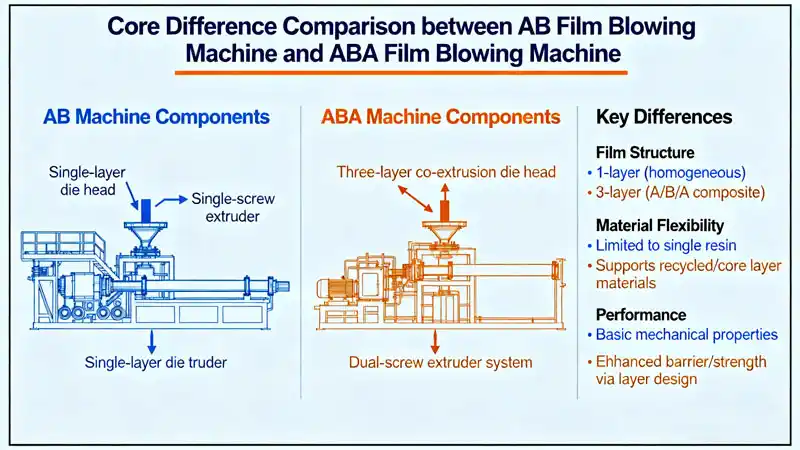
1. Structural Design and Layer Differences
|
Item |
AB Film Blowing Machine |
ABA Film Blowing Machine |
|
Layer Structure |
Double-layer composite structure (Layer A + Layer B) |
Three-layer sandwich structure (Layer A + Layer B + Layer A) |
|
Screw Configuration |
Double screws ( extruding Layer A and Layer B respectively) |
Double screws (the screw for Layer A is mainly for plasticizing, and the screw for Layer B is for conveying filler) |
|
Die Head Type |
Double-layer die head, directly extruding a two-layer composite film |
Three-layer die head, forming a sandwich structure where the outer Layer A wraps the middle Layer B |
|
Core Design Objective |
Functional layering (Differentiated performance of the surface Layer A and the inner Layer B) |
Cost optimization (The middle Layer B is filled with a large amount of low-cost materials, and the two-side Layer A ensures the surface quality) |
2. Use of Raw Materials and Fillers
|
Item |
AB Film Blowing Machine |
ABA Film Blowing Machine |
|
Raw Material Matching |
Layer A: High-quality raw materials (such as HDPE/LDPE to ensure surface performance) Layer B: Recycled materials and fillers can be added (Proportion: 30%-50%) |
Layer A: High-quality raw materials (Layer A on both sides to ensure the film surface luster and printability) Layer B: High-proportion fillers (Calcium carbonate, secondary recycled materials, Proportion: 40%-60%) |
|
Filler Limitation |
The proportion of fillers in Layer B is usually ≤ 50%, focusing on the inner layer functions (such as antistatic property and stiffness) |
The proportion of fillers in Layer B can reach 60%, and it is completely wrapped by Layer A on both sides without affecting the surface quality |
|
Plasticizing Requirement |
The two layers of raw materials need to be compatible to avoid delamination (such as soft material in Layer A + hard material in Layer B) |
The flow channel of the die head is specially optimized, and it is not easy to delaminate even if there is a large difference between Layer A and Layer B materials (such as new materials in Layer A + recycled materials in Layer B) |
3. Comparison of Performance Advantages
|
Item |
AB Film Blowing Machine |
ABA Film Blowing Machine |
|
Cost Advantage |
The cost is 10%-20% higher than that of a single-layer machine, but lower than that of an ABA model (The equipment investment is 20% lower) |
The cost is 50% lower than that of a single-layer machine (Using low-cost materials in the middle layer), but the equipment investment is higher than that of an AB model (Due to the design of the three-layer die head) |
|
Film Performance |
The surface performance (luster, printability) is determined by Layer A, and the inner Layer B improves the functionality (such as stiffness, moisture resistance) The transverse tensile strength is increased by 25% |
The double-sided Layer A ensures high luster and puncture resistance, and the middle Layer B is not exposed. The film surface quality is better than that of the AB model The transverse tensile strength is increased by 30%, close to that of a pure new material film |
|
Production Capacity |
The production capacity is increased by 30% compared with that of a single screw (For example, the AB-70 type is 75kg/h) |
The production capacity is increased by 40% compared with that of a single screw of the same specification (For example, the 2SJ-G70 type is 100kg/h), and the feeding efficiency of the double screws is higher when they work synchronously |
4. Typical Application Scenarios
|
Item |
||
|
Core Positioning |
Double-layer film with high cost performance, balancing performance and cost |
Sandwich film with low cost and high performance, extremely reducing the raw material cost |
|
Applicable Products |
- Daily packaging: Garment bags, simple outer bags for food - Industrial film: Dust-proof film, moisture-proof bags - Functional requirements: Antistatic and moisture-proof inner layer, glossy outer layer |
- Supermarket bags: Vest bags, continuous roll bags (Requiring LOGO printing, with high surface quality requirements) - Heavy packaging: Fertilizer bags, feed bags (The middle layer is filled to enhance the stiffness) - Cost reduction scenarios: High proportion of recycled materials, and it needs to pass the quality inspection (Such as the supermarket access standard) |
|
Thickness Range |
0.015-0.15mm (Focusing on medium-thin films) |
0.02-0.05mm (Focusing on thin films, such as supermarket continuous roll bags) |
5. Summary of Core Differences
•Structural Essence: AB is "double-layer differentiated function", and ABA is "three-layer sandwich cost reduction";
•Filler Strategy: Layer B of AB serves as an auxiliary function, while Layer B of ABA is the core of cost (Higher proportion and wrapped);
•Performance Focus: AB balances the functions of the two layers, and ABA focuses on surface quality and extreme cost reduction;
•Application Scenarios: AB is suitable for basic functional layering requirements, and ABA is suitable for scenarios with high surface quality requirements and a need to greatly reduce the raw material cost (Such as supermarket packaging, heavy packaging).
When selecting a model, you can comprehensively judge according to "whether double-sided high-quality surfaces are required", "the upper limit of the filler proportion", and "the quality inspection standards of the target products".