Air-cooled granulator
-
Suitable material
HDPE, LDPE, LLDPE, PO, CPE -
Reducer
146 Type (Hard Tooth Surface Reducer) -
Main motor
11KW-6*1 (Frequency converter control) -
Particle cutting machine
0.75KW (Frequency converter control)
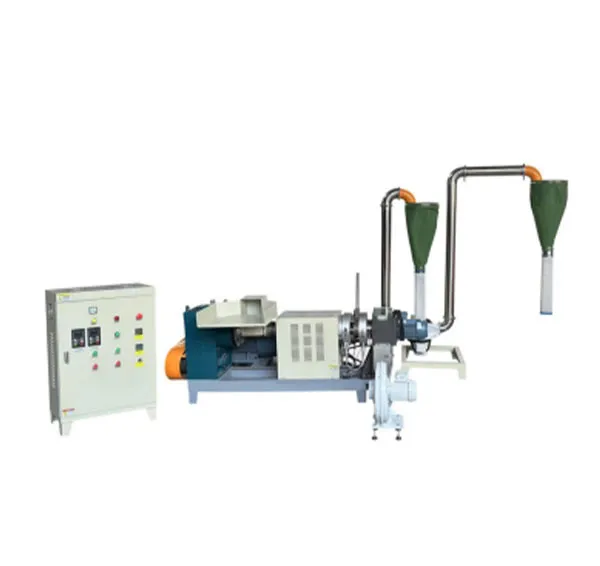
Widely used in industries such as plastics and rubber, it features a relatively simple structure, low energy consumption, and easy operation, making it suitable for production scenarios where a high cooling rate of granules is required.
|
Electrical components |
China Chint |
|
Reducer |
146 Type (Hard Tooth Surface Reducer) |
|
Main motor |
11KW-6*1 (Frequency converter control) |
|
Particle cutting machine |
0.75KW (Frequency converter control) |

|
Screw diameter |
φ75mm (Air-cooled) |
|
Production capacity |
50KG/H (Varies according to the state of different raw materials) |
|
Applicable raw materials |
HDPE LDPE LLDPE PO CPE |
|
Tools |
One operation manual, one set of preparation knives and one distribution cabinet |
|
Overall dimensions |
2100mmx1700mmx2100mm (L*W*H) |
|
Weight |
700KG |
|
Accessories |
One operation manual and one grease gun |
|
The method of changing the filter screen |
It comes standard with no filter screen device, but you can also choose to add a manual quick filter screen replacement device |
|
Total power |
~15kw |
|
Working current |
25A |
What is the service life of a granulator?
The service life of a granulator typically ranges from 5 to 10 years, depending on equipment maintenance, usage frequency, and working environment. Regular maintenance and timely replacement of worn parts can help extend its service life.
How can the quality of pellets produced by a granulator be ensured?
By controlling raw material quality, appropriately adjusting temperature, speed, and the cooling system, and selecting suitable molds and blades, the consistency and high quality of pellets can be ensured.
What are the common issues with granulators and their solutions?
Common issues include unstable output, uneven granule size, and material jams. Solutions include inspecting the temperature control system, adjusting the cutting tools, and cleaning the feed hopper to ensure the equipment operates normally.
How can the production efficiency of a granulator be improved?
Production efficiency can be enhanced by optimizing production processes, setting appropriate temperature and pressure parameters, selecting efficient auxiliary materials, and regularly cleaning and maintaining the equipment.
What is the primary function of a granulator?
A granulator is used to process plastic or other materials into pellets through extrusion, heating, cooling, and other processes. It is widely used in waste plastic recycling, recycled plastic production, and the plastic processing industry.