English
 Español
ou need a film that seals on the inside, prints on the outside, and blocks oxygen in the middle. One material can‘t do all three. Lamination works but adds cost and a step. A Blown Film Machine with ABC co‑extrusion solves it differently. Three extruders feed three different materials into a single die, producing one bubble with three distinct layers — each doing its own job. This guide explains how the ABC setup works, where it outperforms ABA or monolayer, and what to look for when buying a three‑layer line.
A different material for each surface? Yes.
In ABC co‑extrusion, each letter stands for a layer coming from a dedicated extruder.
-
Layer A (outer) contacts the world. It needs printability, gloss, and scuff resistance. Typical materials: LDPE, LLDPE, or HDPE.
-
Layer B (middle) is the functional core. It provides oxygen or moisture barrier. Common materials: EVOH for oxygen barrier, nylon for puncture resistance, or CaCO₃‑filled PE for cost reduction.
-
Layer C (inner) contacts the product. It needs heat sealability and food‑contact safety. Usually LDPE or LLDPE‑based sealant resins.
Monolayer film uses one material and compromises everywhere. ABA uses two materials but the outer and inner layers are the same. ABC uses three, letting you optimize each surface independently while adding a dedicated barrier core.
Not all three-layer film is equal.
The choice between ABC and ABA comes down to whether you need the inner and outer surfaces to be different. ABA is symmetric: the same material on both sides, with a filled or recycled core for cost savings. It dominates garbage bags, shopping bags, and agricultural film where both sides face similar conditions. ABC is asymmetric: each layer can be a different formulation. This matters for stand‑up pouches requiring a sealable inner layer, a printed outer layer, and a barrier middle layer. It matters for medical packaging needing a sterile inner surface and a tough outer layer. It matters for frozen food film where you need low‑temperature seal inside and puncture resistance outside.
| Feature | ABC Co‑extrusion | ABA Co‑extrusion |
|---|---|---|
| Number of distinct materials | Up to 3 | Up to 2 |
| Layer symmetry | Asymmetric | Symmetric |
| Barrier core option | Yes (EVOH, nylon) | Limited (filled PE only) |
| Inner vs. outer properties | Can differ | Must be the same |
| Typical applications | Stand‑up pouches, medical, high‑barrier food | T‑shirt bags, garbage bags, agricultural film |
| Extruder count | 3 | 2 |
Inside the die: three channels, one exit.
The heart of any co‑extrusion line is the multi‑manifold die. In an ABC setup, the die has three independent spiral mandrel distributors stacked vertically. Melt from extruder A enters the outer distributor, extruder B feeds the middle, and extruder C feeds the inner. Each melt travels through its own channel and combines only at the very lip of the die — just as the bubble forms.
This design requires precise temperature control. EVOH, for example, needs a narrower processing window (170–210°C) than LDPE (160–190°C) or nylon (220–250°C). The die must maintain different temperatures in different zones simultaneously — a capability not found in entry‑level co‑extrusion dies.
What happens if you swap A and C?
The sequence A‑B‑C is conventional but not the only option. Some barrier structures put the EVOH core in the B position because EVOH loses barrier properties when wet and needs protection from moisture on both sides. Others put the sealant on the inner side (C) and the structural resin on the outer side (A). The die design determines which extruder feeds which position, so layer order is fixed in hardware. Specify your desired order when ordering the machine — field swapping later requires a new die body.
Real recipes that run every day.
Common ABC structures include: LDPE / EVOH / LDPE — oxygen barrier for meat and cheese packaging. HDPE / nylon / LLDPE — high-strength film for vacuum bags, with nylon providing puncture resistance. LLDPE / CaCO₃‑filled PE / LLDPE — downgauged industrial liner with lower cost core. PET / tie layer / EVOH / tie layer / PE — that’s five layers, but ABC is the foundation. The ABC platform can be extended to 5 or 7 layers by adding more extruders and a more complex die. The DEXIANG ABC line supports up to three materials standard; five‑layer configurations are available by request.
Layer thickness ratios are programmable via gravimetric dosing systems. A typical barrier structure might be 15% A (outer seal/print), 70% B (barrier core), 15% C (inner seal). Tight distribution control is critical — variations in the barrier layer directly change oxygen transmission rate (OTR).
Sizing the line for your output.
The screw diameter for each extruder depends on the required layer ratio. If your B layer needs 70% of total volume, its extruder should be larger than the A and C units. Common configurations:
| Configuration | Extruder Sizes (A/B/C) | Total Output (kg/h) | Film Width (mm) |
|---|---|---|---|
| Small line | 45mm / 55mm / 45mm | 80–120 | 400–800 |
| Mid line | 55mm / 75mm / 55mm | 150–250 | 800–1200 |
| Large line | 65mm / 90mm / 65mm | 250–400 | 1200–2000 |
DEXIANG offers custom screw combinations based on your target output and layer ratio. The line runs thicknesses from 0.02mm to 0.15mm and supports LDPE, LLDPE, HDPE, EVOH, nylon, and biodegradable resins like PLA and PBAT.
Don’t overlook these three details.
Three areas deserve special attention. First, die temperature zone control — ABC requires independent temperature control for each layer’s distributor. Ask how many zones the die has and whether they can run EVOH and PE simultaneously. Second, layer ratio flexibility — some dies have fixed geometry that limits how thin the barrier layer can go. For high‑barrier EVOH, you need the ability to run B layers as thin as 5–10% of total thickness without losing uniformity. Third, screw design for EVOH — EVOH is shear‑sensitive and degrades in standard LDPE screws. DEXIANG offers dedicated barrier screws with shallower channel depths and smoother transitions. If you plan to run EVOH or nylon, specify that upfront.
DEXIANG’s take on the ABC line.
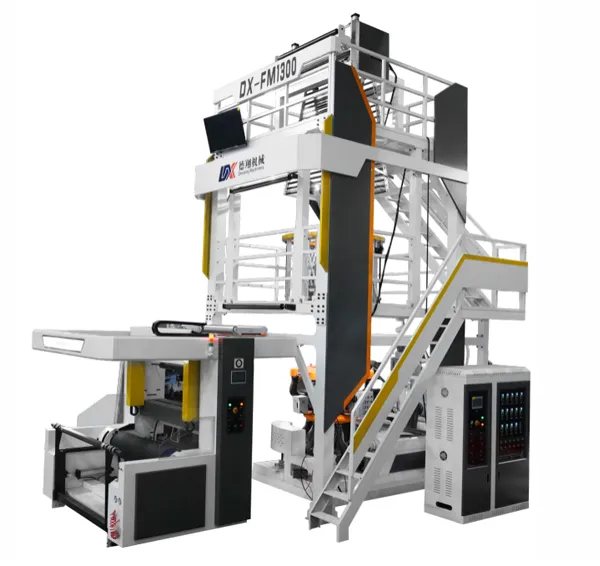
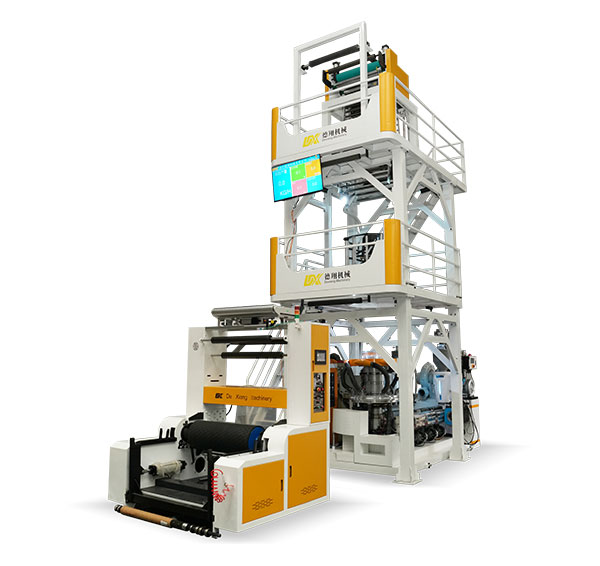
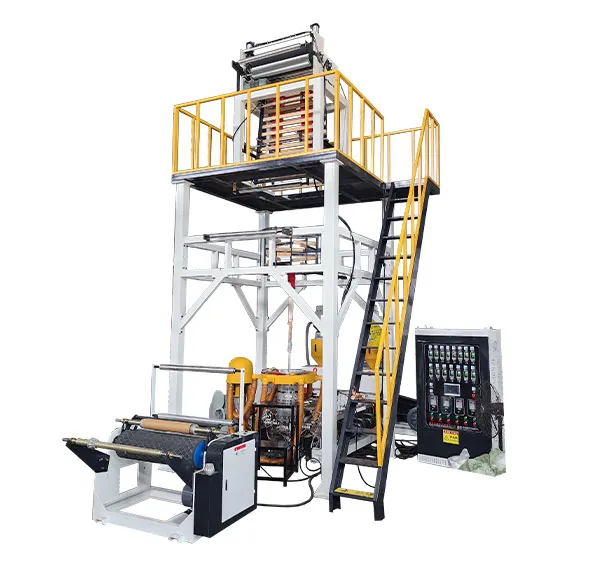
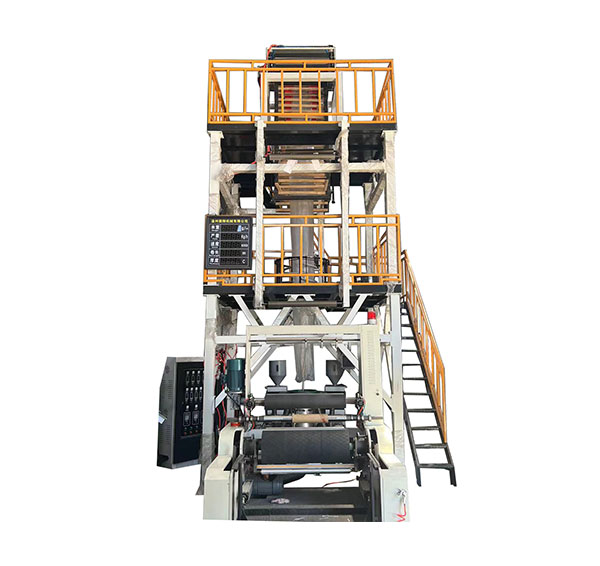
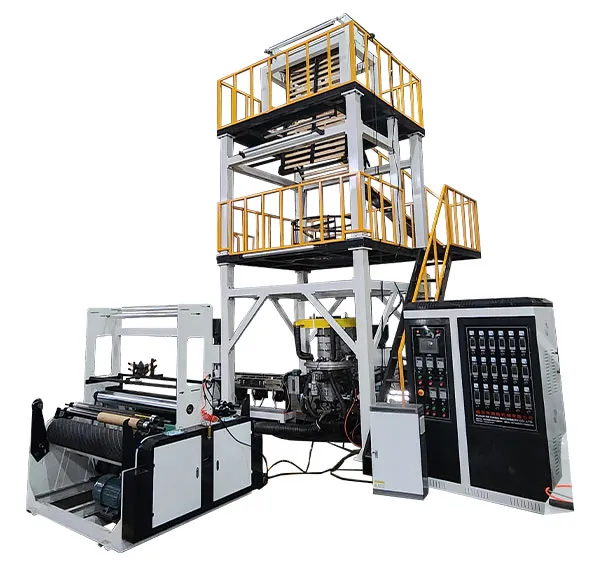
The ABC Blown Film Machine from DEXIANG is designed for converters who need true asymmetric three‑layer structures. The line includes three extruders (sizing based on your layer ratio), a three‑manifold spiral die with independent zone heating, IBC (internal bubble cooling) with ultrasonic stability control, a gravimetric dosing system for each extruder, and a dual‑station surface winder for continuous operation.
What sets DEXIANG apart is the integration of Inovance PLC controls with real‑time thickness measurement. The system adjusts extruder speeds and die gap automatically to maintain target layer distribution within ±3% variation. A production facility running high‑barrier food pouches reduced EVOH usage by 12% after switching to DEXIANG’s closed‑loop control — because they no longer needed over‑spec barrier to compensate for variation.
The company provides on‑site installation supervision, operator training, and a 12‑month warranty on all components. Spare parts are stocked in regional warehouses with 48‑hour delivery to most Asian and Middle Eastern markets.
Your questions, answered.
Can I switch between ABC and ABA on the same machine? Not without changing the die. ABC and ABA require different internal flow channels. DEXIANG offers separate machine platforms for each configuration.
What’s the minimum production volume for ABC to make sense? If you run over 300 tons per year of barrier film (food, medical, industrial), ABC pays for itself through material optimization. Below that, toll co‑extrusion or ABA may be more cost‑effective.
Does ABC cost more to operate than ABA? Yes, because three extruders consume more energy and require more maintenance. But the film value per kilogram — barrier performance, seal integrity, downgauging potential — is significantly higher.
Can ABC run recycled content? Yes, in the core layer (B position) if that layer doesn’t contact food. Many DEXIANG customers run 30–50% recycled PE in the middle layer while keeping virgin material on the outer and inner surfaces.
Ready to move from ABA to ABC?
ABC co‑extrusion isn’t for every blown film line. It’s for producers who need to run three different materials — one for printing, one for barrier, one for sealing — in a single pass. If your customers ask for oxygen barrier, low‑temperature seal, or distinct inner/outer properties, ABC is the answer.
Calculate your current cost of converting. Are you buying pre‑laminated films? Are you rejecting rolls because seal strength fails or oxygen transmission is too high? An ABC line puts control back in your hands.
【Request a quote from DEXIANG for the ABC Blown Film Machine】 — Share your target film width, thickness, layer structure preferences (layer percentages and materials), and monthly output in tons. Their engineering team will recommend extruder sizes and die configuration with a ROI projection.